

I Am Truly Grateful
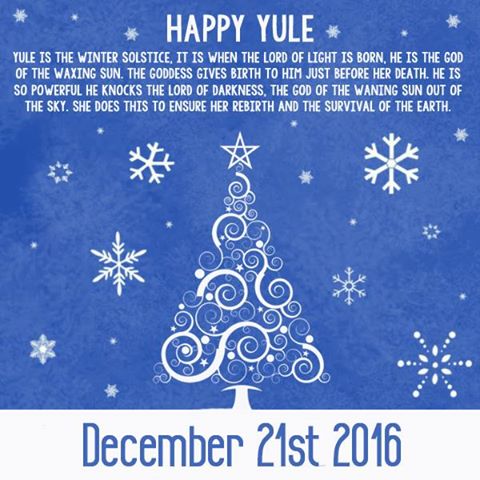
Today is Yule. It is celebrated on the Winter Solstice, which is the longest night of the year. After this night, the nights will start to get shorter and the days with grow longer. It is the rebirth of the Sun.
Ancient people were hunters and farmers and spent most of their time outdoors. The seasons and weather played a very important role in their lives. Because of this, many ancient people had a great reverence for, and worshiped the Sun. The Norsemen saw the sun as a wheel that changed the seasons. It was from the word for the wheel, houl, or jol, that the word Yule is thought to have come.
Every six months there is a Solstice. On the Summer Solstice, the longest day of the year and shortest night, the Waning Sun takes control of the skies and the days get shorter and nights get longer, the cold starts to set in and vegetation on the earth begins to die. On the Winter Solstice, the Waxing Sun takes over and the nights start to get shorter and the days longer. It is a sign that Spring is only a few months away, where life will begin anew and the earth will start to blossom and bloom.
On Yule we celebrate the return of the Waxing Sun. In Wicca it is the birth of the Sun God who has many names; Cernunnos, Pan, The Oak King, Apollo, Sol, Freyr, Horus, Mithras, The Horned God, The Green Man, Lord Of Light, and more. The Goddess gives birth to him on this night. She sacrifices herself to give life to the Lord Of Light to ensure the earths survival.
In ancient tradition, Yule was celebrated with a large fire where townsfolk and villagers would dedicate it to the Sun God. They would fill their home with evergreens and an evergreen tree to show that even though the land was barren and dead; life is still flourishing, They would decorate the tree and their home with shiny objects to encourage the Sun God to shine.
We use Holly and Mistletoe on Yule as symbols of the fertility of the God and Goddess as they grow in the Winter. The red berries of the Holly represent the blood of the Goddess and the white berries of Mistletoe represent the semen of the God to ensure a healthy Spring and harvest to come.
Fill your Yule altar with fruit, nuts, and winter seasonal fare such as fallen leaves, fallen tree branches, acorns, evergreens, and anything bright and shining. Light yellow, green, red, white, or orange candles to ensure a good year and honor the season. Make an offering of wine, grapes, juniper berries, apples, nutmeg, cinnamon, or cloves to the Gods to honor them and wish for a happy new year.
The Winter Solstice has been celebrated by many ancient cultures, one of the most famous being Saturnalia. The ancient Romans held a festival to celebrate the rebirth of the year. Saturnalia ran for seven days from the 17th-23rd of December. It was a time when the ordinary rules were turned upside down. Men dressed as women and masters dressed as servants, the servants were given lavish gifts and their masters made them a big feast. The festival also involved decorating houses with greenery, lighting candles, holding processions, and giving presents. A Saturnalia Tree would be the centerpiece of every home.
Yule is a celebration of light and the Sun, and its life-giving properties upon the earth. It is a time to rejoice and to be thankful for all we have, and to gather strength for the new year. It is a time to contemplate on the year that has gone and look to the future.
The Winter Solstice falls on the longest night of the year (this can fall anywhere between the 20th-23rd of December) and was celebrated in Britain long before the arrival of Christianity. The Druids (Celtic priests) would cut the mistletoe that grew on the oak tree and give it up as a blessing. Oaks were seen as sacred and the winter fruit of the mistletoe was a symbol of life in the dark winter months.
It was also the Druids who began the tradition of the yule log. The Celts thought that the sun stood still for twelve days in the middle of winter and during this time a log was lit to conquer the darkness, banish evil spirits, and bring luck for the coming year. To make a Yule log, cut a log into twelve pieces and burn a piece every day for twelve days. With each piece burned, make a wish for the coming new year.
Today we welcome back the Lord of Light. Blessed Yule to all.
Written credit goes to: Wicca Teachings
Edited by: Lisa Marino
Photo: Various
“And while she was fire,
So fierce and so wild,
I could only hope to be for her;
The forests and the winds to carry her flame.”
―Morris R. Gates
I fell in love with this song hearing it for the first time. Sending much love to my brother. XOXO.
Having worked for several professional athletes, one of whom did return early due to migraines and concussions, I know this is a serious issue. In fact, it’s one I experience myself.
“Grief turns out to be a place none of us know until we reach it. We anticipate (we know) that someone close to us could die, but we do not look beyond the few days or weeks that immediately follow such an imagined death. We misconstrue the nature of even those few days or weeks. We might expect if the death is sudden to feel shock. We do not expect the shock to be obliterative, dislocating to both body and mind. We might expect that we will be prostrate, inconsolable, crazy with loss. We do not expect to be literally crazy, cool customers who believe that their husband is about to return and need his shoes. In the version of grief we imagine, the model will be “healing.” A certain forward movement will prevail. The worst days will be the earliest days. We imagine that the moment to most severely test us will be the funeral, after which this hypothetical healing will take place. When we anticipate the funeral we wonder about failing to “get through it,” rise to the occasion, exhibit the “strength” that invariably gets mentioned as the correct response to death. We anticipate needing to steel ourselves the for the moment: will I be able to greet people, will I be able to leave the scene, will I be able even to get dressed that day? We have no way of knowing that this will not be the issue. We have no way of knowing that the funeral itself will be anodyne, a kind of narcotic regression in which we are wrapped in the care of others and the gravity and meaning of the occasion. Nor can we know ahead of the fact (and here lies the heart of the difference between grief was we imagine it and grief as it is) the unending absence that follows, the void, the very opposite of meaning, the relentless succession of moments during which we will confront the experience of meaninglessness itself.” —Joan Didion
This is SO DAMN TRUE, it’s scary! 😦
Since the moment I first got sick the suggestions people gave me were unreal. The suggestions began with “just needing to pray harder” and gradually made their way to biofeedback, grounding, crystals, supplements, and more. I honestly am not sure which was worse, but I do know that suggestions and trying alternative medicine have only made a hard life with chronic illness harder.
When a doctor gives me a medication and it doesn’t work I don’t get blamed for the failure. However, when I try an alternate medicine I nearly always do get blamed for the failure. When it was biofeedback, I wasn’t trying hard enough or practicing enough. When it was acupuncture, I wasn’t trying to relax hard enough. Even with supplements, I just hadn’t waited long enough for the benefits (no matter how long I waited).
It is…
View original post 1,217 more words