How To Be A Client An Editor Wants To Work With

Author’s Note: These are all true experiences. I will never name names, but I’m not going to filter my honesty either. If something I say here offends you, then you probably don’t want to be a writer. 

11391782_571280002974635_4049651769842289849_n

Not every client I work with is a breeze, but a small percentage are truly fabulous (One I had this week was wonderful.). There has been a tiny percentage over the last 20 years that have enraged me with their constant inquiries, rude comments, whining, tantrums, or those who simply do not understand the process.

It’s 2015, so I think it’s important for writers, especially new writers seeking publication by any means, to understand that editors are human beings. We have families, we have things that go wrong in our lives, and no matter how much we may love what we do, we’re just like everyone else. We have bills to pay, we have responsibilities, children to raise, meals to prepare, animals to care for, homes to clean, clothes that have to be washed, etc. Why would you treat your editor as a lower life form and expect them to respond well to you? I wouldn’t treat a stranger the way some people treat their editors, so here are a few things I feel are crucial information for you to have.

If you’re about to work with an editor or are currently in the process, even for the smallest project, here are some surefire ways to be a good client and not make said editor contemplate a move to a Brazilian rainforest (Another good goal is not to end up on a list of clients they’ll refuse to do business with in the future.)

#1- Don’t call or e-mail within 15 minutes of sending them your manuscript to ask if they’re finished. I JUST started. I’m on page three. Why are you asking if I’ve read the entire thing that you JUST sent to me? Precisely how does one get it into their head that a non-magical entity has just inhaled 100,000 words (or more) in 15 minutes?! It is annoying to the point of something more severe. Here, let me whip out my magic wand…  Don’t do it, and if you’re thinking about doing it, lock your phone in a drawer and change all of your passwords to stifle yourself.

A good editor will update you during the process, there is no need to nag. You may find yourself so excited that you can’t help but constantly send your editor messages, but eventually, even the best editor is going to lose their patience with repetitive questions. The only time it’s acceptable to keep track of them is, if by some strike of lightning, you never hear from them again, which happens to people on occasion. However, a person that responds to you and keeps you updated is working, and you probably aren’t their only job, so be patient. Take this from a person who is being nagged every few days by a client. If strangling were legal…  

#2- Don’t say rude, insensitive, inappropriate, idiotic shit. If an editor lets you know right away that they are dealing with any kind of emergency (We’re people, life/shit happens and it’s not always good.) decide whether or not you can hold out. If they are in the middle of the work, let them finish. Continuity is important. Hiring another editor to do what they’ve been working on is a headache because that person will only start from the beginning and make changes more suitable to their style, and that’s additional time, and money, being spent.

If they just started working and you’ve barely paid them, it’s okay to move on if need be, but don’t take hostility out on them or, if you agree that you can wait, don’t send them messages every few days, or weekly, to ask about the progress. Let them work. If I have to stop what I’m doing to answer your repetitive e-mails, I might not be pleasant, polite, or anywhere near the word “professional”. I might give you one word answers. If I respond three days later, that does not mean I was ignoring you. It means I was working. Don’t make assumptions. 

#3- Realize that every freelance editor does not have a team behind them and/or a slew of assistants. I’m a one-woman show. There are days I knock out 25,000 words in the editing and/or proofreading process and there are days I am only able to get through a few pages. The dirtier the manuscript, the more face time it requires.

#4- Read your work in advance before you submit it. You might even want to read it twice. Use spell check. Hell, use a grammatical tool so I don’t stare at the page flabbergasted by your complete and utter lack of knowledge regarding the use of the English language. “Did she actually write “ancestory” instead of “ancestry”? I think I’m having a stroke. (This happened to me Thursday.) That is not a typo (look at where each letter is on your keyboard), it’s someone trying to sound out a word and failing, miserably.   

#5- You may have a few self-published titles under your belt, but that doesn’t make you a writer. Yeah, I said it. Anyone can self-publish. If you don’t have an audience to sell to and a solid story, don’t make it out to be more than it is. There are some exceptions to this rule and they are people who have properly marketed themselves as a brand. I know a few of them and their decency measures up to the quality of their writing.

#6- You cannot self-promote anything that isn’t edited, clean, and ready to go. It’s childish and unprofessional, and it’s not going to work in your favor the second a prospective agent Googles you and finds your blatant self-promotion, for a book they may or may not want to buy, in places they probably don’t want to see it. They might like your chutzpah, because you will need those skills later on, but they’re not going to want unedited excerpts on every writing web-site from here to Calcutta. Know when to hold things close and even better, know when to keep your mouth shut. Unless something is a done deal contractually, zip it. Afterwards, I’d still refrain.

#7- Write what you know. If you’re choosing a place you have never been and will never visit, you’re not going to capture the essence of the most crucial things, and a local resident or someone who has been there is going to pick up on that immediately. There may be a lot of competition to write about things in major cities, but if you’ve actually made the statement that Johns Hopkins University and their respective Hospital are in New York City when it most certainly is not (Hello, have you ever heard of Baltimore, Maryland?! Unless I’ve had a recent lobotomy, they’re both still there.), I strongly recommend NOT making New York City your setting. (Yes, this happened. I had to walk away from the crazy because insistence does not make something truth.)

#8- Speak to me, on the phone & in e-mails, the same way you want to be spoken to. If you’re incessantly rude, eventually even the nicest person is going to snap. Ultimately, treat people the way you want to be treated, in all things.

#9- You may love your editor, but he/she is not your bestie. Unless we’re genuine friends outside of work, I cannot take time to counsel you on your marriage, friendships, parents, or children. Not when you constantly ask me “Is it done yet?” It’s NOT a piece of chicken.

#10- An editor who knows his or her shit is going to push you to be better. We are going to tell you to re-write, revise, and altogether tell a better story. It’s our job to dissect what you’ve written and help you make it into a cohesive, readable body of work. Telling you it’s the most fabulous thing I’ve ever read when it is not and kissing your ass for writing it “in three months” is NOT in my job description. I can tell when something took no time at all.

#11- There is a relatively long list of words I will cut out of a manuscript the second I see them in an overly repetitive fashion. “Very”, “Awesome”, “Seriously”, “Really” “Totally”, “Umm”, “Just” “Ya” as opposed to “Yeah”, are merely a few. The deal-breaker is “Alright”. I flip my lid every time I see it and you’re out there calling yourself a writer. Don’t insult me, I’ve been writing for 28 years and I’m almost positive I have always known that “all right” is two fucking words, not a creative amalgamation for the lazy. If ever I DID make errors like that, there was always someone present to correct me.

The occasional slip-up is not the end of the world, but if you regularly use the word “Y’all”, or any variation thereof, please exit stage door left so I don’t throw something. I realize it’s a part of some people’s daily vernacular, but if you’ve written it into a book that does not take place south of the Mason-Dixon line, I’m cutting it.

#12- If you want five hundred pages edited in 1-3 days, you’re either looking to hire a machine or highly intelligent zoo animals. Let me know how that works out for you. (This is a regular request. These are the same people who think this level of editing shouldn’t cost more than $30 U.S., not Canadian. I would rather starve for a week than do that much work for so little money. That’s not even my current hourly rate!)

The very best editor for you is someone you have fostered some sort of professional, communicative relationship with, maybe even someone you know who edits and who you have come to respect, but it’s not the person you picked out of a line-up as the cheapest person for the job. Unfortunately, sometimes you get what you pay for and other times you find someone amazing. It’s the luck of the draw.

At the end of the day, I do not have all the answers. I have 95% of them, but not all of them. 😉

copyright © 2015 by Lisa Marino & Blackbird Serenity LLC. ALL RIGHTS RESERVED.

words

Lisa’s Unwritten Rules #1

11156398_444174409090203_2472701955722653289_n

I have a very long list of ‘Unwritten Rules’. Most of them pertain to manners and common decency, but the rest, in my opinion, center around basic common sense.

If you’re a writer and you’re in need of an editor, PLEASE do not expect me to work for free. I cannot tolerate being approached for developmental editing, which is extremely time-consuming, only to be told “I have no budget”. Okay, I get that. Which is precisely why I let people contract me out via a payment plan. It’s so easy, you’d have to be a moron not to be able to follow it. If you would buy things on a credit card that you have to pay off monthly, then look at editing as a much more important investment in your future. If you have it done right, you never have to spend additional funds to have it re-done after it’s published and you suddenly find it riddled with unimaginable, not to mention embarrassing, errors.

Very few editors with experience are “inexpensive”. If I charged by the hour, no one would be able to afford me, so I charge based on the type of editing needed. If someone wants a flyer done, that’s not expensive. If you need an editor to critique or simply proofread, again, that’s really not expensive. But a book manuscript? If it were “cheap”, I wouldn’t hire me, I’d run for the hills! I go so far as to hold a spot for you in my schedule if you say “I will need you by a specific date.” The payment plans work out for me too because they help pay my bills and like everyone else, you cannot ignore a mortgage, rent, utilities, the cost of food, etc. They’re basic facts of life.

I am flat-out DONE working for peanuts. Been there, done that. I’m NOT going in reverse. I’m not a teenager or college student who needs to pad her resume or gain experience. Do not bring me a 100,000+ word, 300+ page manuscript and expect that to cost a few dollars to edit, or that I’ll listen to the story of how you desperately want to succeed, but cannot pay me. I can only do so many random acts of kindness before I start feeling like a moron.

It’s perfectly okay to say I don’t fit into your budget and look elsewhere for someone who is stupid enough to work for nothing going to take the job, but don’t disrespect me and then expect us to be “friends”. If you think a monkey can do the edit, then by all means, hire the fucking monkey.

I am one of the easiest people to have edit your work. I am highly communicative, I fact check, I make sure your work is going to grow and be solid down the road. I do a LOT and I’m always available to you. I came up with the idea of payment plans because many people have budgets and I understand that. Not every editor is okay with that though. I know many that ask for the entire amount up front (this could be several hundred dollars or several thousand, depending on how they price things. In-house editors make all of us look inexpensive as freelancers.), or, like me, a percentage to take the job and the rest by the time the manuscript is finished. That’s not an unfair request, especially if I’ve never worked with you before. I do a lot of first edits and final edits for people. When I give someone a price I have to factor in that I proofread it several times, provide extensive notes, and all the other things I previously mentioned. I also have to factor in that I often do research for certain clients. It doesn’t take two days. You have to respect that you’re hiring someone for their talent and ability, and that they’re taking the time to help you become a better writer. You get what you pay for, but many of my clients are astounded by what I have to go through simply to be paid like a human being. When it insults them, it reaffirms that my prices aren’t unreasonable.

When looking for an editor, look at the character of the person. I’ve had many people tell me they got a friend to help them, but that the friend “didn’t push them to be better”. As someone who strives daily to be better, I understand the need for a fresh set of eyes and someone who will be honest with you. I’m going to point out plot holes and other issues, that way when you re-write it, you know what your strengths and weaknesses are. If it were my work, no matter how much editing I’d done on my own, I’d STILL require an editor myself because I’d need someone who could be detached and push me to be greater. That’s one part of the artistry of being a good writer. Knowing when to detach and allow someone to further along your talents.

NEVER expect that person to A) Do it for free or B) Not have bills to pay. Courtesy and respect begets courtesy and respect. And if ever you don’t mesh well with an editor, do not be afraid to move on to someone else who might be the perfect fit.

Rant over.

copyright © 2015 by Lisa Marino & Blackbird Serenity LLC. ALL RIGHTS RESERVED.

11110813_10153148162026291_2743530395093100523_n

Apparently, Some People Can’t Read Warnings…

10365894_745833075465270_7559614670578208065_n

I think I make myself incredibly clear. Clear to the point of overly repetitive! I’m starting to think I should come with a warning label, because some people are so stupid they cannot read the simplest of statements.

If you read my editor’s profile I strictly state that I will NOT do sample edits. I have done a few, but over time you see that the job you just did a sample for ends up going to someone else. It’s always the person with a lower bid. It’s not about how good you are, it’s about someone saving a few dollars. That’s fine. C’est la vie. However, I have now made it mandatory, part of my own personal policy if you will. I don’t give my work away for free, nor should anyone expect me to do so.

I received an inquiry late last night, complete with a chapter. Not only did the person not ask me anything, they simply said “Can you do a sample page? Thanks.” (I’d like to say that request wasn’t riddled with spelling errors, but it was. A simple request, filled with errors in spelling and grammar. For a second I said to myself “Do I just do it, or am I competing against two dozen other people?” The thought of losing out to someone else over a few dollars made me stand firm. I finally replied “I will only do the sample if I am the only person you are considering for the job. No one worth their salt gives their work away for free. Thank you” That’s not me being a bitch or egotistical, it’s laying down some important ground rules.

I’m always polite and professional, but I truly don’t think anyone worth their salt should give their work away for free. I will work with a person until they are happy with their manuscript, but I don’t think I should have to posture and/or bow down to whatever it is they’re looking for in a “sample”. If you’re hiring someone, read their bio. Look at their list of experience. Choose based on that. I might not always choose the person with the most experience, because sometimes they aren’t the right person for the specific genre, but I will choose the person that instinctively feels right in my soul.

My bio says “27 years of writing experience, nearly 20 years of editing experience.” (January 1st is my 20 year mark. 🙂 ) and lists all of my qualifications and precisely what I specialize in. It also clearly states that I no longer do sample edits because the practice has become unacceptable to me, not to mention it is frowned upon by the employer. Even they tell you that 99% of the time when you do a sample for someone, you will never hear back from the person and not to give your hard work away for free. For me, it’s really not worth it. Yes, I want the job, but I am not going to beg for it, not with an extremely long list of experience backing me up. Choose me because I am right for the job, or choose someone else. Either way, it’s okay.

As a writer, I am extremely careful who I share my work with. I don’t care who you are or how much trust I have in you, my work is MY WORK and there’s a line I simply will not cross. There are only two sets of eyes that have ever looked at my fiction work, and one set of those eyes is my own. Some people have seen brief excerpts or quotes, nothing more.

You really have to be careful to protect your work and shield it. There are thousands of cases in the court system for copyright infringement. There is always someone claiming to own a story when it was simply shared with them in friendship, or as a fresh set of eyes. I sign non-disclosure agreements to protect other people because I respect that they’ve worked hard. I do not want or need their ideas, and it is not my right to steal their work. My word is my bond, but if a piece of paper will also protect a client, then so be it. I feel the same way in kind because I have worked immensely hard on every single thing I’ve ever written.

I was lucky, because I was taught about copyrighting very young. New writers know next to nothing about how to protect themselves or their work, so I often have to step up and say something. Not everything you read on the Internet is true, so when in doubt, ask someone who has some experience.

Many new writers share their work via blogs and various platforms through social media. Therein lies your first mistake. Be a writer, share new material on blogs and social media, talk about new projects, but do NOT release privileged work until it has run the gamut with literary agents, editors, and/or you have already chosen to publish it yourself. Do extensive self-publishing research and don’t fall for any crap. Again, when it doubt, turn to someone knowledgable.

Above all, don’t do anything for work that doesn’t make you feel good about yourself. A sample edit might seem fine to a lot of you, but to an experienced editor who already has a sample of her work posted to her profile, it is a grave insult. I won’t whore myself out for a “maybe”, nor will I whore myself out for a “yes”. If a person cannot show you respect, then you probably don’t want to work for or with them. Remember that. Your personal integrity is so much more important than anything else. It’s something someone can only take from you if you let them. I choose to keep my integrity in tact.

UPDATE: Integrity & Intuition will not lead you in the wrong direction. This person sent a chapter of her work out to every single person, 37 in total. I filed a complaint because clearly she wants free work if she’s doing that, and I usually get sent a prologue or a first chapter, never something in the middle. I was sent chapter 12, and the warning bells went off inside my head. She has listed the same job 4 times. They immediately flagged it and told me to continue reporting anyone that violates the terms of service because I could accidentally be booted for following the rules when I haven’t done anything wrong, but it’s hard when you’ve got 10 million customers and workers to be on top of every single incident. I feel better knowing I did what’s right. Always read the rules. It takes a few minutes, yes, but it gives you knowledge and shows you’re not a moron! I’m many things, a moron isn’t one of them.   

copyright © 2014 by Lisa Marino & Blackbird Serenity LLC. ALL RIGHTS RESERVED.
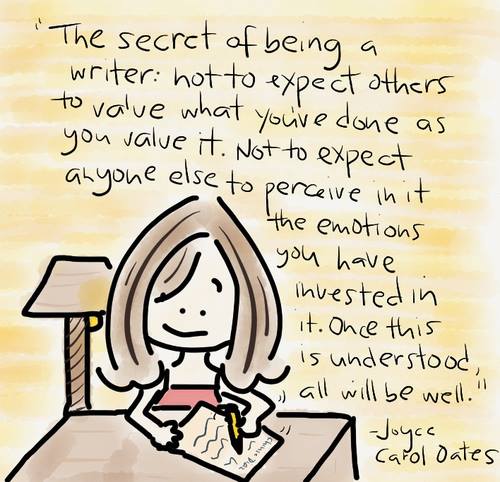
Saturday Morning Humor

I have been lucky (and not so lucky) to read a LOT of books long before they were ever published. The other day I was asked how crucial the editing process is. I said “As an editor, making sure your work is properly edited and not riddled with mistakes and errors is of the utmost importance. I cringe whenever I see something poorly edited.” I expected no response whatsoever, because really, why would I?

Then I noticed that what I said DID raise a comment, and it went a little something like this “Then how do you explain Fifty Shades Of Grey being published?!” I had the hardest time not laughing. I go from speaking from experience to being blamed for work I didn’t even edit! I’m pretty damn sure I was not credited as EL James’ editor, and if I was, I want a retraction, STAT.

I did respond to the ludicrous comment, only because editors aren’t publishers. We can push something and market it to death to a literary agent, but even that really isn’t our job. Marketability is not what I get paid, or in this case blamed, to do. However, as an editor, I do believe in letting the author know precisely how marketable their work is and which direction to take it in.

I’ve told people exactly which agents to submit queries to. A lot of people are first-time writers, have never been published, and even though they have a finished product, they have absolutely no idea what to do with it after the first edit. I advise, but unless I’m on contract, I do not do more than an extremely thorough edit with notes. In most cases, I am the first edit or the last before submission. Some books, while incredibly brilliant, never see the light of day. That is why more and more people are self-publishing and/or going through smaller publishing houses. It’s not an easy process, yet people seem to believe that it is because way too many idiots are on the New York Times Best Sellers List. Only 60% of them have true talent (Hell, I read their books!), and sometimes the numbers are higher or lower, depending on the month. Hand me a book, I will find the errors in the editing and grammar. And yes, it always makes me cringe.

As the consumer, and this goes for me as well, if you don’t like something, don’t fucking read it. Save your receipts, return whatever it is you disliked, and get something new or get a store credit. But don’t blame the editors of the world for what other people write!

copyright © 2014 by Lisa Marino & Blackbird Serenity LLC. ALL RIGHTS RESERVED.
lifeisnot